
pagefile.sys too big: How to Reduce the Space Used
Index
- Introduction
- What is the paging file (pagefile.sys)?
- Why does the paging file get too big?
- How to reduce the space used by the paging file
- Frequently Asked Questions (FAQs)
Introduction
The pagefile.sys file is a component that, under some circumstances, can take up a significant amount of disk space. In this guide, we'll explain how to manage and reduce the space used by this paging file on Windows operating systems, improving space management without compromising performance.
What is the paging file (pagefile.sys)?
The pagefile.sys is a system file used by Windows as virtual memory, also known as a swap file. When the computer's physical RAM (random access memory) is full, older data is temporarily moved to the pagefile on the hard disk. This process is critical because it helps free up RAM for running applications, keeping the system stable and responsive.
For more details, you can consult the Microsoft's guide.
Why does the paging file get too big?
There are several reasons why the `pagefile.sys` can be too large:
- Automatic management: By default, Windows automatically manages the size of the file, which can increase significantly based on usage.
- High memory usage: If you frequently use memory-intensive applications, the system will make heavy use of virtual memory.
- Low installed RAM: Systems with a limited amount of physical RAM tend to rely more on the paging file.
How to reduce the space used by the paging file
By following these steps, you can reduce the space taken up by the `pagefile.sys`:
- Access advanced system settings:
- Press
Win + Pauseon your keyboard, or search for "View advanced system settings". - Click on the corresponding result to open the System Properties window.
- Press
- Configure the paging file:
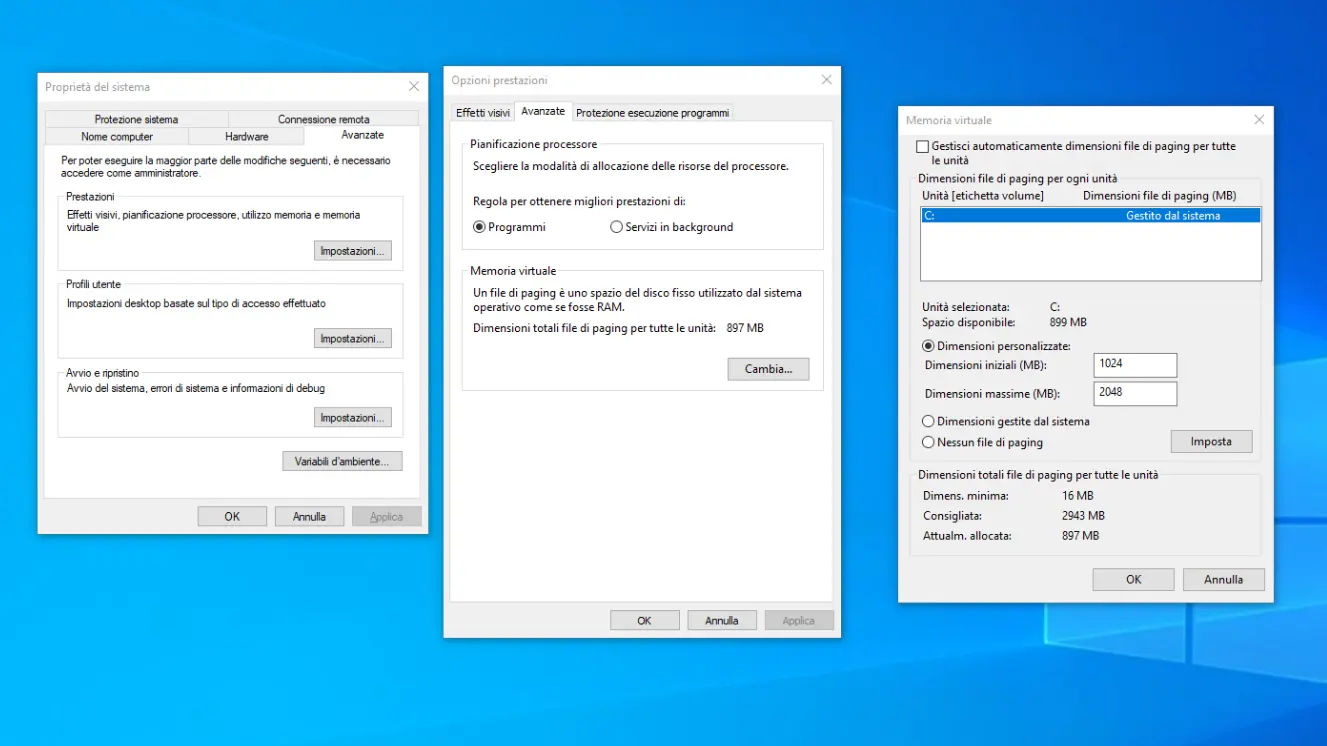
- In the "System Properties" window, go to the "Advanced" tab.
- In the "Performance" section, click on the "Settings" button.
- Open the "Advanced" tab and, in the "Virtual Memory" section, click on "Change."
- Deselect the "Automatically manage paging file size for all drives" box.
- Select the system drive (usually
C:), enable the "Custom size" option, and set a starting and maximum value in MB. For example, you can set 1024 MB as the initial size and 2048 MB as the maximum. - Click on "Set" and then on "OK" to confirm.
- Restart the system:For changes to take effect, you need to restart the computer.
Frequently Asked Questions (FAQ)
What is the paging file?
The paging file, or pagefile.sys, is an extension of your PC's physical memory (RAM) that uses hard disk space to manage data when RAM runs out.
Is it safe to reduce its size?
Yes, it is safe, but it is important not to set values too low. Maintaining a minimum size of at least 1 GB is a good practice to avoid performance problems or system instability.
Can I disable the paging file completely?
Although it is technically possible to select the "no paging file" option, it is strongly discouraged. Disabling virtual memory completely can cause instability, slowdowns, and application crashes, especially when physical RAM is saturated.
Is it possible to move pagefile.sys to another disk?
Yes, it is a common practice to optimize performance. To move pagefile.sys, follow the same procedure as described above: first set "no paging file" for the current drive (e.g., C:), click "Set," then select a new drive (preferably a fast SSD), set the custom size, and click "Set" again. Restart the computer to apply the change.