Migrating from VMware to the Cloud in 2026: Alternatives, Costs, and Strategies
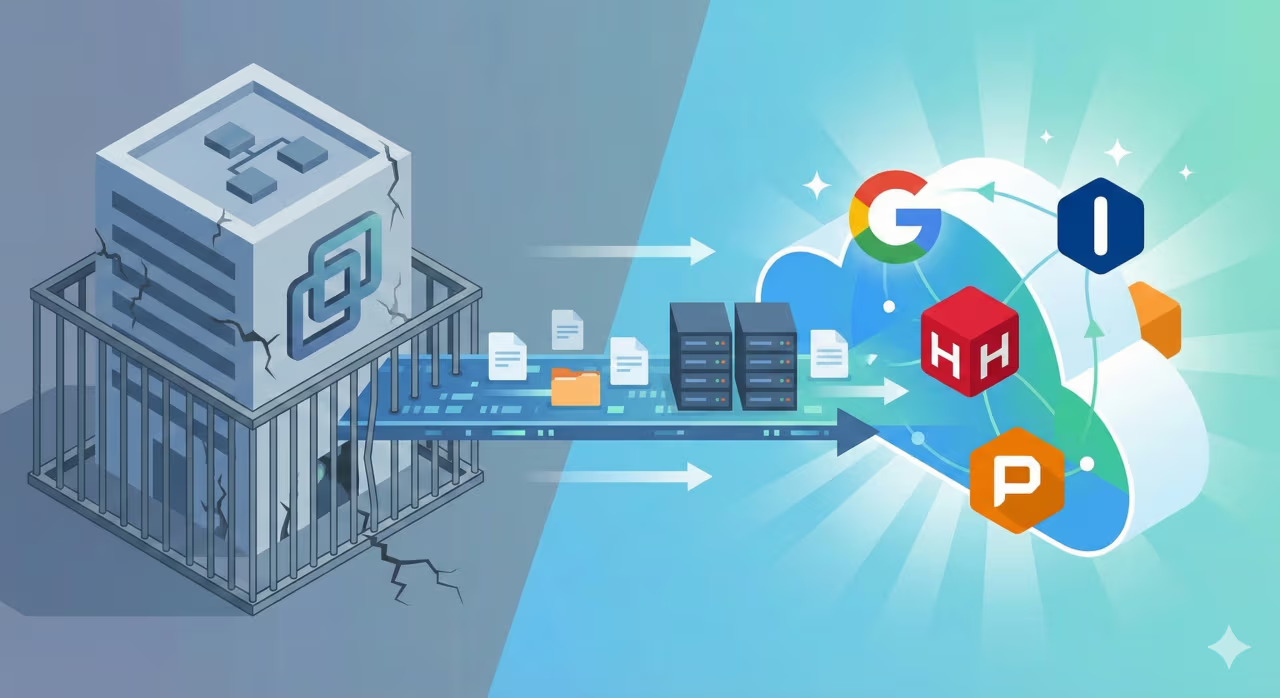
Recent sweeping changes in VMware's licensing policies have transformed enterprise IT infrastructure management. For many organizations, contract renewals result in unpredictable and unsustainable cost increases. This article is a strategic guide for CEOs, CTOs, and Web Agencies wishing to evaluate alternatives to VMware in 2026, exploring migration to best-of-breed cloud providers such as Ionos, Hetzner, Google Cloud Platform, or open source on-premise solutions such as Proxmox. The goal? Take back control, cut costs, and scale without constraints.
Key Points (Highlights)
- Costs and Licensing: Comparative analysis between the new VMware subscription model and public Cloud efficiency.
- Vendor Lock-in: Strategies to modernize legacy infrastructure and regain data sovereignty.
- Cloud Destinations: How to position workloads between Ionos (Enterprise), Hetzner (Pure Power), and Google Cloud (Hyperscalability).
- The On-Premise/Hybrid Alternative: The benefits of Proxmox VE for maintaining total hardware control.
- Zero-Downtime: Secure methodologies to migrate mission-critical workloads without disruption.
VMware License Costs vs Public Cloud: The Impact on the IT Budget
The transition of VMware to purely subscription-based models has generated a great deal of uncertainty in IT departments. Many technical decision makers are now facing an uncontrolled explosion of monthly infrastructure costs, the dreaded "exploding cloud bills" syndrome.
Comparing VMMware vs. Public Cloud licensing costs, the advantage of the cloud lies in the Pay-as-You-Go model (you pay only what you consume). However, a simple "Lift and Shift" (moving virtual machines as-is to the cloud) is not enough to save money. What is needed is a cost reduction through optimization or migration to high-performance providers with predictable costs. This approach, known as FinOps, ensures that every resource allocated is truly utilized, eliminating the waste typical of on-premise over-provisioning.
Authoritative insight: Read the market analysis on the consequences of VMware licensing changes on Computer Weekly to understand the overall industry sentiment.
Modernizing legacy infrastructure and exiting Vendor Lock-in
Remaining locked-in to a single technology vendor exposes the enterprise to enormous strategic risks. The inability to switch vendors because of proprietary technologies (the "Vendor Lock-in") curbs innovation and resets bargaining power to zero. The modernization of legacy infrastructure comes through the adoption of open standards, containerization and agnostic architectures.
Replacing monolithic virtual machines with dynamic environments returns total sovereignty over its data and architectural choices to the enterprise.
Migrating VMware to Ionos, Hetzner and Google Cloud: Choices of Excellence
The alternatives to VMware for 2026 see providers with very different vocations, capable of covering each specific business need:
- Hetzner (The Champion of Pure Power): The elite choice for those seeking brute performance and unmatched value for money. With its dedicated servers (Bare Metal) at hyper-competitive costs and cost-effective traffic, it is perfect for intensive workloads and for those with technical teams capable of managing custom architectures.
- Ionos (The Enterprise and Enterprise "Sweet Spot"): The perfect compromise and recommended choice for most SMBs and Web Agencies. Ionos combines the robustness and support of an Enterprise Cloud (mandatory for CEOs and CTOs) with strict European GDPR compliance. It offers transparent billing, intuitive interfaces, and an ideal level of service for companies that want to outsource infrastructure while sleeping soundly.
- Google Cloud Platform - GCP (The Hyperscalable Choice): The ultimate destination for projects that require complex data architecture, integrated AI, or extreme global scalability. It justifies its premium costs when the business needs the highest level of managed services (such as global Kubernetes).
Planning a Secure and Optimized Cloud Migration
Don't let licensing costs stall your growth. Our Cloud Architects design bespoke migrations to providers like Ionos or Hetzner, ensuring superior performance and total absence of vendor lock-in.
The Open Source Alternative: Migration to Proxmox
For companies that wish to maintain infrastructure in their own data centers (On-Premise) or rent Bare Metal servers (as on Hetzner or Ionos), moving to the public Cloud is not the only way. Proxmox Virtual Environment (VE) has established itself as the leading open source contender in the enterprise market.
Proxmox combines KVM virtualization and LXC containers in a single Web platform, with no hidden or per CPU socket licensing fees. If you're considering this route, I invite you to read my detailed technical article on how to dealing with step-by-step migration to Proxmox.
Tackling Migration: Security and Operational Continuity
One of the biggest restraints for CTOs is the crippling fear of service disruptions during the technology transition. Moving Terabytes of data and dozens of virtual machines is a delicate operation.
The solution lies in a rigorous engineering methodology. With careful planning, failover testing and asynchronous replication in the background, it is possible to perform a management of guaranteed "Zero-Downtime" migrations from On-Premise to Cloud environments (and vice versa). This ensures that end users do not experience any disruption during the operational switch.
Frequently Asked Questions (FAQs)
What are the best alternatives to VMware in 2026?
The alternatives depend on the architecture: Proxmox VE for On-Premise/Bare Metal environments, or public Clouds such as Ionos (for Enterprise/cost balancing), Hetzner (for brute power) and Google Cloud (for global scalability).
Is it possible to migrate from VMware to Cloud without disruption (Zero-Downtime)?
Yes. Using continuous replication tools at the block level, you can synchronize data to the destination and schedule the "cutover" reducing the downtime to a handful of seconds or minutes, being transparent to the end user.
Is migration to Ionos or Hetzner safe for corporate data (GDPR)?
Absolutely yes. Both are European providers that guarantee datacenters located in Europe (e.g., Germany, Spain), offering strict GDPR compliance, making them excellent for handling sensitive data compared to non-European providers.